Pages

Tuesday, December 21, 2010

The Future: Sustainable Architecture

It is inherently human to construct in order to protect us from the natural elements. We can see this instinct as far back as the early Homo erectus who frequented the same spot in the coast of Nice, France. Here, this group of Homo erectus undertook the task of creating every year a dwelling from wooden structural members and utilizing rocks placed around the perimeter to erect their structure. This construction, called the Terra Amata, is believed to be the earliest known human-constructed dwelling (Roth 161). The most interesting fact about it, is not that it is one of the first constructions created by humans, but that in this age of information, characterized by its ample use of human made materials such as steel, reinforce concrete, and glass; we want to return to constructing with these simple raw materials like wood, flora, and rocks. This movement to create buildings using biodegradable and ecological resources to limit the impact of construction on the environment is called sustainable architecture. This architectural movement to go green has faced different kinds of objection regarding material sources, reliability, and costs but the reoccurring critique coming from the architectural world is how the implementation of environmental sciences will affect the aesthetic design of architecture. Many believe that the artistic quality of architecture will be undermined with the aspect of sustainability but through investigation and research; we can show that aesthetics can be incorporated into environmental friendly buildings, therefore creating an architectural style that is sustainable and visually pleasing.
As we begin to notice the damaging effects we have caused on our environment, it is clear to us that our current methods have to be changed in order to improve the health of our planet. One technique that has surfaced is the implementation of sustainable building design to combat the destruction of the environment. Sustainable architecture is a broad term used to describe the environmentally conscious effort in the field of architecture.
The implementation of early sustainable architecture first began in the 1970s as many prominent architects began to use simple sustainable techniques to design their buildings. One clear example of this is the Frederick C. Robie House in Chicago by Frank Lloyd Wright. The design of the house fully implements to use of roof overhangs to maintain the temperature inside the building (Roth 143). These overhangs that surround the house cast a shadow in the summer months, disallowing the sun to penetrated within the building and heating it up, and allows the passage of the sunlight into the house in the winter months to keep it warm. This simple but yet efficient technique allowed for the reduced use of electrical appliances to maintain comfortable living conditions, therefore reducing the consumption of energy and the emission of hazardous gasses into the atmosphere.
This technique is an example of passive solar heating systems. These work by allowing solar radiation to fall on thermal masses, such as floors and masonry walls, which soak up the heat and then radiate it back into the building at night (Cunningham, Cunningham, and Saigo 454). Passive solar heating systems are usually also implemented with active solar heating systems to allow for more precise control. With active solar heating systems, collector panels absorb solar radiation, and a fluid circulating in pipes through the panels picks up the solar heat and transfers it around the building (Cunningham, Cunningham, and Saigo 455).
Solar radiation is a source of heat that helps to maintain warm living conditions within a building, but in hot climates solar radiation can increase the interior temperature to unlivable levels. In these regions of the world, such as India, windows are not made from glass but instead are composed of pierced panels of carved marble. This is implemented to reflect the solar radiation away from the building and to allow the circulation of air throughout the construction (Roth 140).
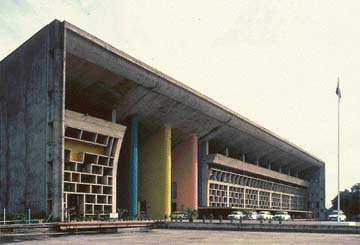
Architects such as Le Corbusier also implemented parasol-like roofs on top of their buildings to shadow the structure from the radiation of the sun. These parasols where mainly very large roof overhangs that would create a vast shadow on the building. Le Corbusier went a step forward as to not only include the parasols on his High Court Building in India, but to create large vent-like openings below the roof to allow currents of cool air to circulate through and air-condition the building (Roth 144).

Monday, December 20, 2010

Post and Lintel


This is a picture of the north wall of the Salt Lake City Public Library. I think that the post and lintel system used here adds a strong and pronounced architectural feature to the design of the library. The window frames also emphasize the system of columns and posts.

I Photoshoped the image, played with gray-scale, contrasts, masks, hues, and colors.

Copyright Diego Pardo.

Sunday, December 19, 2010

West Seattle Residence


I tend to like the all-industrial design and its simple use of architectural simplicity, but in this house the implementation of these makes it seem empty and cold. The warehouse section of the house does have a great design, especially with the vast windows, but personally the windows make the house feel naked. I think that the glass curtain removes the privacy and comfort of the home.

I don't want to sound hasty, because design-wise, it is a very good one. BUT in my opinion the hangar-like design takes away from the feel of the home. It reminds me more of the AEG turbine factory in Berlin by Peter Behrens than a house, right?


Description from the architects, Lawrence Architecture:

A modern house on view property with 3,800 SF of living space and a 925 SF detached garage. Primary materials include concrete, steel, and glass. A concrete wall up to twenty-four feet high organizes the site and the house: the garage, entry and service spaces are on the street side of the wall, while providing privacy for the main living space which is a curtain wall-enclosed pavilion. The wall is also the organizing element for the circulation including the stairs with cantilevered steel treads. Supported on steel frames and triangular steel trusses, the roof swoops over the concrete wall capping the pavilion. Eight by sixteen foot sections of the curtain wall pivot for ventilation. The stair has demountable guardrails which are normally in place but were removed for the photographs.

The master bedroom is in a loft space above the kitchen, while a family room, media room, children’s bedrooms and bathrooms occupy the daylight basement level. There is additional living space above the garage accessible via stair or future elevator.


Saturday, December 18, 2010

The Outlined

I worked on this digital piece a while back. It incorporates three of the buildings in downtown Salt Lake: the Walker Center, Chase Building, and the Wells Fargo Building.

I photograph this picture in day and through Photoshop I played with the image and came up with this.

I wanted to accentuate the outline of the three buildings and the truss system on top of the Walker Center by reducing the contrast and adding a soft gradient to the sky.

This is one of my favorite pieces.

Copyright Diego Pardo.

Height, Space, and Glass (Comparison of the Burj Khalifa, Amiens Cathedral, and The Pompidou Center)

Architecture has seen through time specific buildings that radicalize the way buildings are design and constructed. Some of these buildings have revolutionized the way we reach the heavens, utilize our space, and reinvent new methods for use of different materials. These innovative buildings helped to reshape what we as humans could construct and helped to redefine the realm of architecture. This paper will analyze, compare, and contrast three of these radical buildings, the Burj Khalifa, Amiens Cathedral, and the Pompidou Center; and how these employ height, space, and glass in their designs.

The culmination, thus far, to build a structure that reaches towards the heavens is the Burj Khalifa. This mega-structure located in the city of Dubai in the United Arab Emirates is the tallest building in the world at a staggering 828 meters. It is officially classified by the Council on Tall Buildings and Urban Habitat (CTBUH) of the Illinois Institute of Technology to be the only structure to be placed number one in all three height categories; these include height to architectural top, highest occupied floor, and height to tip.
The architectural firm in-charge of the construction of the Burj Khalifa was Skidmore, Owings & Merrill LLP, who from the start had to use the latest in building technology in order to construct the tower. The 20 billion dollar project utilized conventional building methods and materials, but applied new techniques to make the revolutionary construction possible. These included wind-resistant design, structural load of concrete, window strength, and even new methods to lift the concrete to the higher floors for pouring (Baker).
The architects and engineers also took inspiration from the Hymenocallis flower to create the floor plan of the building. Also, Islamic patterns of architecture were added to accentuate the tower’s design as well as to create visual references to the culture of Dubai. This led to the triaxial, Y shape, of the base of the tower. This Y-shape became ideal as it maximized the views from the residential and hotel rooms and also created the least wind-resistant structure (Baker, Pawlikowski, and Young).
The Burj Khalifa utilizes reinforce concrete for its skeleton structure that spirals as it ascends to emphasize the height of the tower. The structural system of the tower is a buttressed core, as each wing of the Y-shape buttresses the other. Also, the columns of the tower are design to withstand the gravitational and lateral forces of the building (Baker, Pawlikowski, and Young). This skeleton is covered by a curtain of glass windows that extends from the bottom to the top of the building. These windows have endured strict tests in order to uphold during wind and sand storms. These also have to reflect the solar radiation of the sun as temperatures in Dubai can exceed 110 degrees Fahrenheit (Big, Bigger, Biggest: Burj Dubai).
Using the buttressed core system and implementing most utility features in the central shaft of the tower, has allowed the architects to utilize the remainder of the space. This is very important as the larger the behavioral space in the building, the larger real estate revenue will be produced; especially since the majority of the building will be residential and office space.
There is now doubt that the magnitude of this building can be dumbfounding. This building truly rips the sky with its sheer size. But before we could reach such daring heights, the antecedent of this skyscraper was hand crafted my master masons.

Around the 12th century a new form of architecture began to emerge. Gothic architecture originated in France and it focused on the grandeur of the cathedral. Before this time, constructions could not support large windows or tall ceilings, as the structural load put on the walls would collapse the building. Gothic architecture tackled these problems by introducing three structural members: the flying buttress, pointed arch, and rib vault. The flying buttress is a supporting arch located on the outside of the cathedral to counteract the lateral forces created by the exterior wall. The pointed arch differs from the traditional Roman arch as it redirects the stress line to the ground instead of to the sides. This redirection of the stress line ultimately made it possible to build taller. The rib vault is composed of two intersecting pointed arches. This structure channels the weight of the ceiling to the columns in order for the walls to not carry the full load of the ceiling. The collaboration of these structural members in the Gothic cathedral would yield the first modern skyscraper as its structural members helped to utilized height, large behavioral space, and walls of glass (Building the Great Cathedrals).

One of these first skyscrapers is the cathedral of Amiens in France. Constructed in 1220 through 1269 by Bishop Evrard de Fouilly, it became one of the tallest Gothic cathedrals in Europe. The architects involved in the design and construction were Robert de Lu- zarches, Thomas de Cormont, and Renaud de Cormont. In order to reach the celestial heights it did, the architects building this cathedral had to push its structural members to its limits. This eventually led to structural weaknesses as the design and materials could not support the weight of the building. In order to counteract the failing structure, new flying buttresses were added centuries later to combat the forces of the exterior wall. Also, iron chains were added to the walls along the entire length of the cathedral to hold the central columns in place (Addis, Murray, and Building the Great Cathedrals).

These additions to Amiens Cathedral ultimately saved the building from completely collapsing. But beyond the structural weaknesses of the cathedral, the architects successfully created a tall structure that encompassed a large behavioral space and also included large windows to illuminate the interior. These windows can be observed all throughout the building from the large round window above the main entrance, to the windows surrounding the altar of the cathedral, and the clearstories running along the top of the nave and transept. These stained glass windows not only worked as a source of natural light, but also depicted stories from the bible, therefore having more than just one utilitarian use. Besides this, they also had a spiritual purpose, as the windows created a sense of awe and admiration that strongly reflected the spirit of God. Eventually, this early form of a glass curtain would also be implemented in today’s skyscrapers.

Besides the stained glass windows, the cruciform design of the floor plan strongly reflects the influence of the Catholic Church in Medieval Europe. Architects used the cross as the inspiration to create the floor plan of cathedrals, making this design the standard for cathedral design. The floor plan of Amiens, like most Gothic cathedrals, was able to have a large behavioral space. This was possible not only by the three structural members previously mentioned but by removing the structural members of the building to the exterior of it. By doing so, new constructions could be built using thin walls, which allowed the Gothic cathedrals to greatly expand their surface space and allow for thousands of people to be within them at any single moment. This was revolutionary as no other building type had been able to create a large covered area.

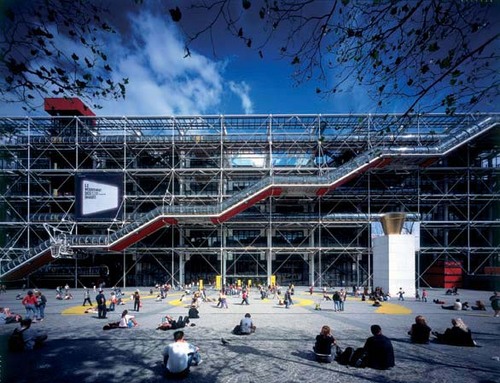
Also in France, we find a building that fully uses its behavioral space by placing its structural members in the exterior of the building. This structure is the Pompidou Center located in Paris and built from 1971 to 1977. The French president at the time, Georges Pompidou, commissioned for a new center of art and culture. This led to a competition among international architects to create the winning design for the new center. The architects chosen for the project were Renzo Piano, Richard Rogers, and Gianfranco Franchini. They came up with a modern design that used extravagant designs like moving floors and large electronic screens as facades; all of these strongly reflecting the emergence of the digital age. But due to budget issues, the profligate design qualities of the new art center were abandoned (Prestinenza Puglisi).

The design of the Pompidou Center was first inspired by the work and research of Buckminster Fuller, the Italian architectural firm Superstudio, and other High-Tech architecture influences. Piano, Rogers, and Franchini sought to create a building that reflected the machine and its utility (Prestinenza Puglisi). They achieved this by removing all of the pipes, vents, and ducts from the interior to the exterior. This created a jungle of metal works that surrounds the façade of the art center. Furthermore, they installed an escalator across the front of the building, enhancing the aspect they wanted to convey of a machine-based era.

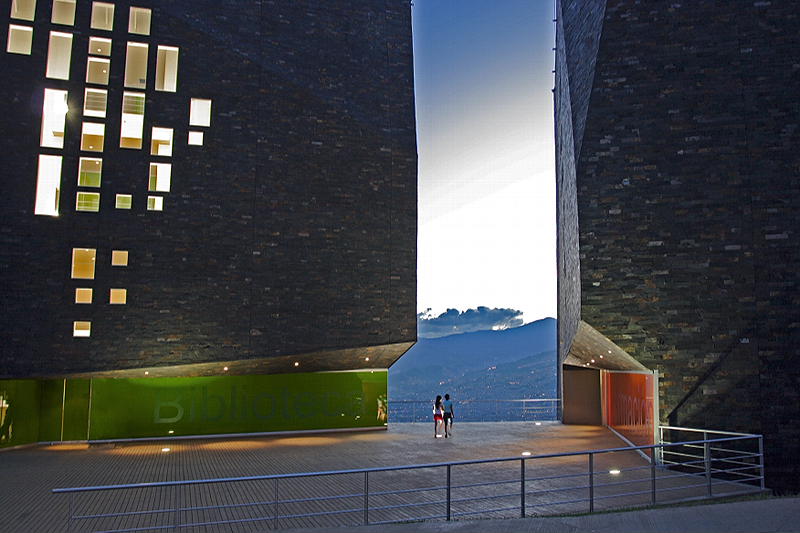
Biblioteca Parque Espana (Parque Espana Library)

The Biblioteca Parque Espana is a library located in Medellin, Colombia constructed in 2007.

It's erected along the hillside overlooking the valley of the city. The Colombian architect who designed this library, Giancarlo Mazzanti, hoped to create a structure that would reflect the nature of the surrounding environment.

Clearly, he was able to create a building that resembles giant rocks. From afar, the library looks as if it was part of the topography of the landscape, incorporating the building into the environment.